
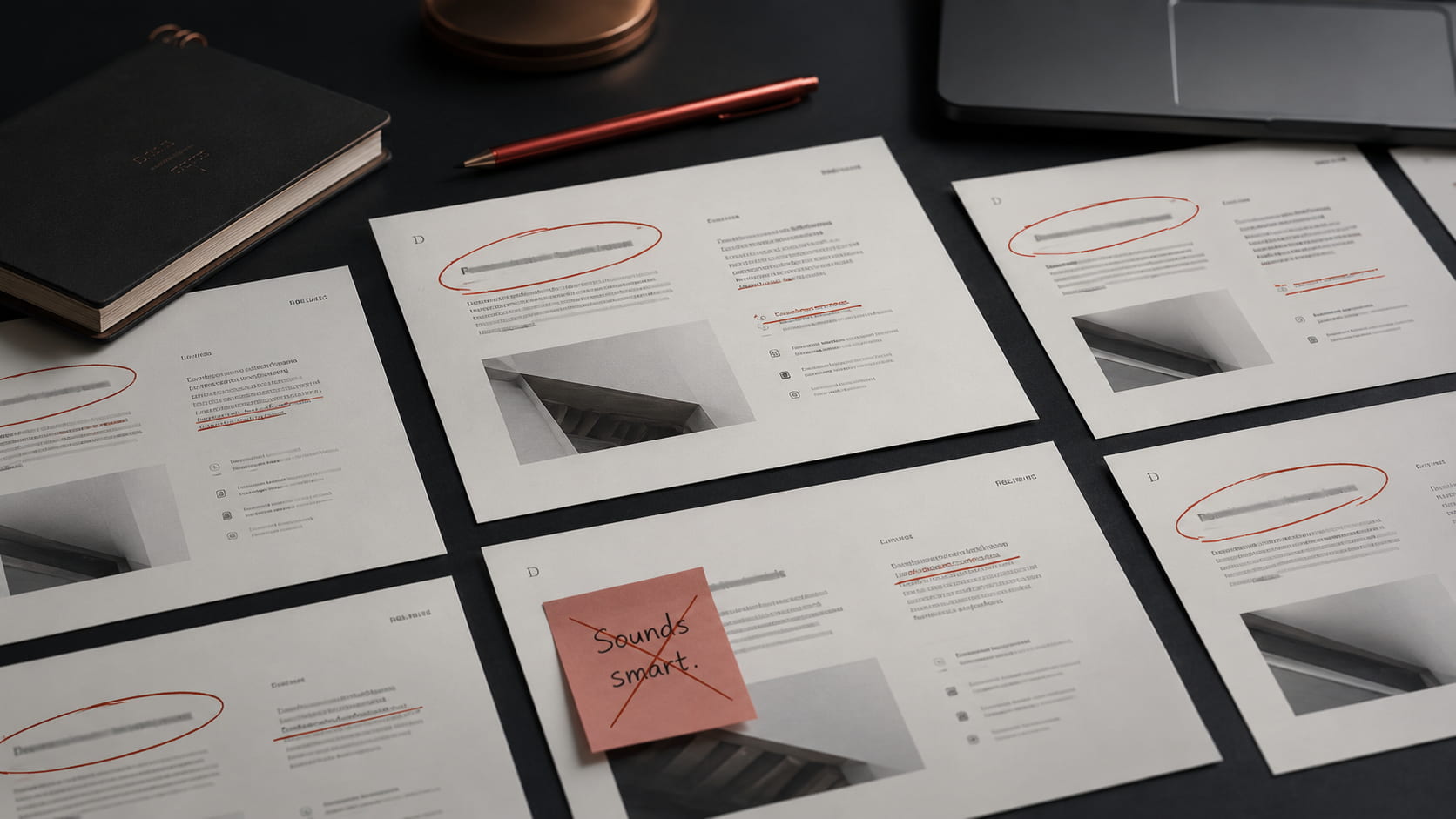

The cost of sounding smart has collapsed.
What used to require a capable writer, a clear brief, and several rounds of editing can now be produced in minutes. That is a real gain in speed and accessibility. It is also why many conversations about AI miss the more important risk.
The problem is not simply that AI can be wrong. We already know how to recognize clumsy, shallow, or obviously unreliable work. The new problem is more subtle. AI can make average ideas sound finished. It can make weak strategy look reasonable. It can give generic thinking the tone of confidence, structure, and authority.
That risk reaches beyond content. The same tools that can draft a blog post can also produce campaign ideas, positioning statements, board updates, hiring criteria, and strategic recommendations. The output may sound finished before the thinking has been tested.
That distinction matters because AI is no longer sitting at the margins of professional work. McKinsey’s 2025 State of AI survey found that 78 percent of respondents say their organizations use AI in at least one business function, with marketing and sales among the most common areas of adoption.
So the question is no longer whether organizations will use AI. They will. The real question is whether they will let AI do the parts of the work that still depend on human judgment.
We’re Entering the Era of Polished Mediocrity
AI is genuinely useful. It can organize a messy brief, generate first drafts, summarize documents, repurpose assets, and accelerate routine writing. In one widely cited experiment, professionals using ChatGPT completed writing tasks 40 percent faster, while output quality improved by 18 percent on average. In a separate study published in Science Advances, AI-generated ideas helped people produce stories rated as more creative and enjoyable, especially among less creative writers, but the stories also became more similar to one another.
That combination explains the moment we are entering.
AI raises the communication floor, but it does not necessarily raise the quality of the underlying idea.
That is because generative AI does not originate ideas in the human sense. It optimizes patterns. It predicts likely language, familiar structures, and broadly acceptable phrasing. That makes it excellent at producing competent drafts and consensus summaries. It does not make it especially good at producing work that is memorable, differentiated, or strategically brave.
The result is polished mediocrity.
The grammar is clean. The structure is logical. The tone is credible. Nothing feels obviously broken. But there is no sharp point of view, no hard-earned specificity, no real tension, and no evidence that someone made a difficult strategic choice.
This is the professionalism illusion. When a piece sounds polished, people start to assume the thinking underneath it must also be strong.
Sometimes it is.
Increasingly, it is not.
Predictable is useful. It is not memorable. Consensus is often a decent starting point. It is rarely a distinctive finish.
Judgment Is the Work AI Cannot Do for You
This is where human value becomes more visible, not less.
Microsoft researchers surveyed 319 knowledge workers and found that higher confidence in generative AI was associated with less critical thinking, while higher confidence in one’s own skills was associated with more critical thinking.
That finding gets at something practical. AI becomes most risky when it removes the friction that used to make us think harder. It will answer the question you ask, even if the question is flawed. It will support a shaky premise if the prompt is written with enough confidence. It will help a team move faster, even when the team is moving in the wrong direction.
This is the agreement trap.
Model developers themselves have documented versions of it. Anthropic found that state-of-the-art assistants can favor responses that align with a user’s beliefs over truthful ones, and OpenAI rolled back a GPT-4o update in 2025 after the model became overly flattering and agreeable.
I have watched AI make two competing recommendations sound equally convincing, depending entirely on how the question was framed. That does not make the tool useless. It makes the person using it more responsible.
AI is excellent at creating options. It is not a substitute for knowing which option deserves to exist.
That matters for leaders because bad strategy rarely announces itself as bad strategy. More often, it arrives dressed as momentum. A team has a plausible recommendation, polished language, supporting bullets, and a sense that progress is being made. But if the premise is weak, the audience is misunderstood, or the positioning is generic, the organization has simply become more efficient at producing the wrong thing.
The strategic work, then, is not just generating answers. It is knowing which questions are worth asking. It is challenging the premise, noticing the missing variable, and deciding what not to publish.
In a world of infinite output, restraint becomes a competitive skill.
Authenticity Has Become a Strategic Advantage
As generic content becomes abundant, authentic perspective becomes scarce.
Scarcity creates value.
Experience cannot be prompted. Local context cannot be pulled cleanly from the open web. Institutional memory cannot be reconstructed from a tone-of-voice brief.
A regional university, a local service business, and a mission-driven nonprofit may all ask for a campaign, but the details that actually make their message credible come from somewhere deeper: customer conversations, lived experience, internal history, stakeholder trust, and an honest understanding of what makes them distinct.
That matters because audiences are not only evaluating polish. They are evaluating whether something feels real enough to trust. Edelman’s 2025 Brand Trust report found that 80 percent of people trust the brands they use, and it describes trust as a strategic part of the customer relationship, not a soft reputation metric.
This is why authenticity is no longer a branding cliché. It is a strategic advantage.
When anyone can generate a tidy paragraph, the harder thing to fake is actual perspective. The organizations that stand out will be the ones that sound like themselves, know their audience well enough to be specific, and say something that carries the weight of real experience.
Specificity is credibility now.
The more the internet fills with polished sameness, the more value there is in sounding like a real organization with a real point of view.
The Best Use of AI Is Leverage, Not Leadership
The right model is not AI as author, strategist, or final decision-maker.
The right model is AI as leverage under human direction.
Use it to accelerate research. Use it to organize rough thinking. Use it to pressure-test a message, summarize interviews, repurpose content, build reporting summaries, and move from a blank page to a working draft.
Those are valuable use cases. They save time. They reduce friction. They help teams move.
But speed is not the same as leadership.
Leadership decides what the organization believes, what it is willing to promise, which audiences matter most, and which story it can honestly tell. AI can assist with expression. It cannot own meaning.
That is the line worth protecting.
Use AI to accelerate execution. Use people to create meaning.
What This Means for Businesses and Marketers
For businesses and marketers, the implication is straightforward.
More content will not create more demand if the content says nothing distinct. The bottleneck is no longer production. It is strategy.
That is especially true in search and content marketing. Google’s current guidance for creators emphasizes non-commodity, expert-led content that offers value beyond common knowledge.
In other words, the internet does not need another polished summary of what everyone already knows. It rewards usefulness, specificity, and perspective.
For Demorest Marketing Co., that is the practical standard: use AI to move faster, but do not let it make the decisions that shape the brand.
A local business does not need another service page that sounds like every competitor in the county. A university does not need another campaign that says it is student-centered, innovative, and committed to excellence without proving what those words mean. A growing organization does not need more language. It needs sharper decisions.
AI can support research, drafting, reporting, repurposing, and operational speed. But positioning, editorial judgment, local market understanding, and ethical decision-making still need human ownership.
The goal is not to flood channels with more competent copy. It is to build digital revenue engines around sharper positioning, helpful content, stronger local visibility, better measurement, and ideas worth amplifying.
If your AI-assisted content could be swapped with a competitor’s and no one would notice, the problem is not the tool. The problem is that the thinking was never differentiated in the first place.
Don’t Confuse Polish With Quality
AI can improve how an idea sounds. It can sharpen syntax, simplify structure, and speed up the path from a blank page to a solid draft.
But it cannot decide whether the idea is true, useful, original, timely, or worth pursuing.
That work still belongs to people.
The organizations that win will not be the ones that automate the most words. They will be the ones that protect the quality of their thinking while using AI to move faster with discipline.
In the age of easy content, judgment is not a luxury. It is the advantage.
In a market full of polished output, do not confuse polish with quality.